
Assistive mobility
Wearable structures that may provide mechanical support during gait, depending on the use profile and professional assessment.
EXOMOBILIDADE BRAZIL
ExoMobilidade is structuring the introduction of intelligent exoskeletons and assistive mobility technologies in Brazil, connecting engineering, healthcare, research and human performance.
Technologies and partnerships presented here are subject to technical, regulatory and commercial validation in Brazil.
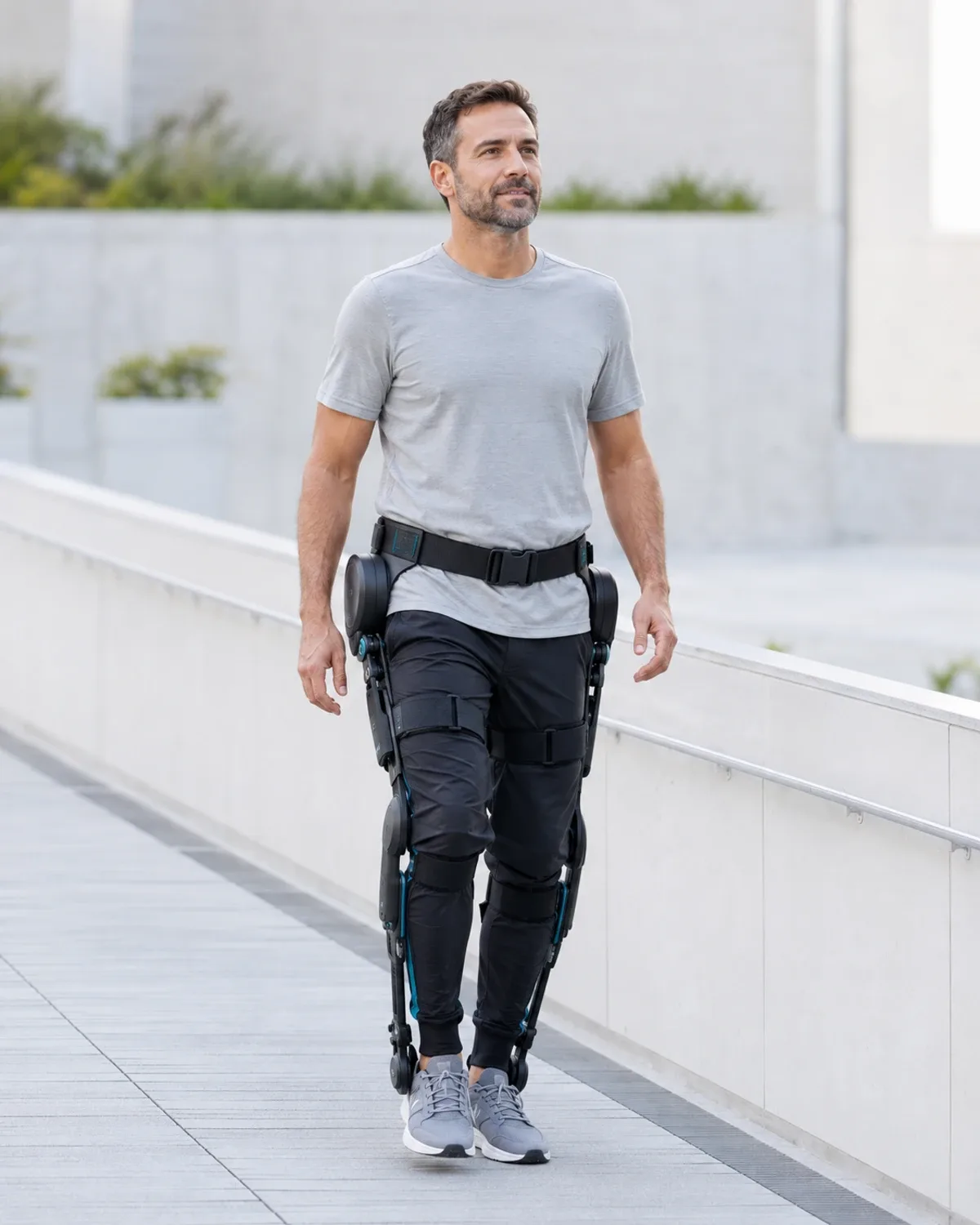
Powered lower-limb exoskeleton demonstration.
TECHNOLOGY
Motors at the hip and knee joints assist walking, reducing muscular effort and supporting the body through movement transitions — sitting, standing, and climbing.

Front view

Side view

Rear view

| Action | Without assistance | With ExoMobilidade |
|---|---|---|
| Walking long distances | Higher muscular effort | Partial movement support |
| Climbing slopes and ramps | Pronounced fatigue | Knee torque assistance |
| Maintaining upright posture | Postural compensation | Additional structural support |
| Sit-to-stand transitions | Effort peak | Help initiating movement |
The values above describe the intended behaviour of the equipment and still depend on independent technical validation in Brazil.
POSITIONING
Powered exoskeletons combine adjustable structures, sensors, actuators and control systems to follow certain movement patterns. ExoMobilidade works to evaluate these technologies with technical, regulatory and institutional responsibility before their introduction to the Brazilian market.
Wearable structures that may provide mechanical support during gait, depending on the use profile and professional assessment.
Potential use in controlled settings, supervised by clinical teams and governed by each institution's own research protocols.
Applications in training, trails, occupational ergonomics and reduction of perceived effort during long-duration activities.
THE PRODUCT IN MOTION
An exoskeleton only makes sense in motion. Below, different use contexts show how the structure follows the body, where the actuators sit, and how the equipment is put on and adjusted.


Visual materials are based on the manufacturer's public demonstrations or on original conceptual imagery. Specifications and applications are subject to independent technical validation.
APPLICATIONS
Support while walking daily routes, reducing effort over long distances or uneven terrain.
Explore application
Assistance on inclines and trail routes, keeping a natural walking pace.
Explore application
Support for supervised conditioning and functional training programs.
Explore application
Use in biomechanics studies and testing of new assisted mobility technologies.
Explore application
Support for rehabilitation processes led by qualified health professionals.
Explore application
Reduces physical load in tasks requiring repetitive or prolonged effort.
Explore application
Walking support for older adults or those with muscle loss, reducing daily effort. This is not a medical device; use should be guided by a health professional.
Explore applicationHOW IT WORKS
The cycle below describes, in general terms, how wearable assistance systems typically operate. Specific parameters vary by manufacturer, model and configuration.
Sensors identify the user's movement, posture and intent.
The system processes signals and determines the appropriate level of assistance.
Actuators provide mechanical support during certain movements.
The system can adjust assistance according to usage pattern and environment.
We do not publish figures for precision, speed, battery life or performance without a verifiable public source from the manufacturer.
COMPONENTS
Hover or tap the highlighted points to see what each assembly does. Descriptions are general to the product category.

View component detail
USE PROFILES
Different contexts impose different requirements. The table below organises the use profiles under evaluation, with their respective demands and known limitations.
People with preserved mobility seeking to reduce effort during travel and long-duration activities.
Urban walking, stair climbing, extended time on foot, active ageing.
Individual fitting, usage training, predictable surfaces, initial supervision.
Does not replace professional assessment. Weight, battery life and comfort vary by model and user.
Usability testing, body-type suitability and safety verification for home use.
Universities, biomechanics laboratories and rehabilitation centres with dedicated technical teams.
Gait studies, institutional research protocols, effort and ergonomics analysis.
Controlled environment, protocol approved by the institution's ethics committee, trained staff.
Use restricted to the approved scope. Does not constitute clinical indication or treatment.
Institutional approval, applicable regulatory analysis and outcomes defined by the institution itself.
Trail, mountaineering, cycling and fitness practitioners; occupational teams.
Trails with elevation gain, long crossings, backpack loads, reduced perceived effort.
Dust and moisture resistance suited to the environment, energy planning, contingency plan.
Uneven terrain, water and extreme temperature impose restrictions. Check the manufacturer's limits.
Controlled field trial, risk assessment and verification against official manufacturer specifications.
OPPORTUNITY
Brazil brings together a large hospital network, rehabilitation centres, universities, healthcare professionals, companies and consumers interested in innovation. Introducing exoskeletons, however, requires local support, training, regulatory analysis, maintenance and structured pilot projects.

PARTNERSHIPS
ExoMobilidade seeks partnerships with manufacturers of wearable technologies, exoskeletons and assistive mobility solutions interested in evaluating the Brazilian market.
If you represent a manufacturer, a hospital, a university or a rehabilitation centre, we can set up a technical conversation about demonstrations and pilot projects.